Richard
Have you ever sat down to tackle a massive project, only to find yourself staring blankly at the screen for twenty minutes? Your heart rate climbs, your palms get slightly damp, and suddenly, even the simplest sentence feels like it’s written in a foreign language. This isn’t laziness or a lack of intelligence; it is a physiological “system crash.” In psychology, we call this the tipping point of Cognitive Load Theory. It is the moment your brain’s processing power is completely maxed out, leaving no room for new information.
Understanding how to manage this mental limit is the secret to high performance, whether you are a corporate executive or a student facing a mountain of coursework. When the pressure to perform becomes too high, many people realize that trying to “power through” actually makes the work worse. This is why smart professionals and students often look for ways to offload the mental burden. For instance, finding a reliable Assignment Help provider like myassignmenthelp can act as an external hard drive for your brain, allowing you to focus on high-level thinking while experts handle the exhausting technicalities of research and formatting.
The Architecture of the Human Mind: Working Memory vs. Long-Term Memory
To understand why we “freeze” under pressure, we have to look at the hardware of the human brain. Cognitive Load Theory (CLT), first formulated by John Sweller in the 1980s, is based on the idea that our working memory has a strictly limited capacity.
Think of your Long-Term Memory as a massive, nearly infinite warehouse. It can store decades of facts, faces, and skills. However, your Working Memory is like a tiny workbench in front of that warehouse. Every new piece of information you process must sit on that workbench before it can be moved into the warehouse. If you try to put fifteen heavy tools on a workbench designed for three, the bench collapses.
When you are stressed, your brain doesn’t just have to deal with the task at hand; it also has to deal with the “noise” of anxiety. This noise takes up physical space on your workbench, leaving you with almost no room to actually solve problems or write effectively.
| Feature | Working Memory | Long-Term Memory |
| Capacity | Very Limited (7 ± 2 items) | Virtually Infinite |
| Duration | 10–15 seconds (without rehearsal) | Permanent / Years |
| Function | Processing & Decision Making | Storage & Retrieval |
| Vulnerability | Highly susceptible to stress/noise | Stable once encoded |
The Three Pillars of Cognitive Load
Sweller’s theory breaks down mental effort into three distinct categories. Understanding these is the first step toward reclaiming your productivity.
1. Intrinsic Load: The Core Difficulty
This is the inherent complexity of the task. For a math student, “2 + 2” has a very low intrinsic load. However, “calculating the trajectory of a satellite while accounting for atmospheric drag” has a very high intrinsic load. You cannot change the intrinsic load of a topic, but you can change how you approach it by breaking it into smaller “chunks.”
2. Extraneous Load: The “Mental Junk”
This is the most dangerous type of load because it provides zero value. Extraneous load is caused by things like poor instructions, a loud office, a messy digital desktop, or a confusingly designed textbook. When you spend ten minutes trying to figure out how to start a paper rather than actually writing it, you are wasting your working memory on extraneous load.
3. Germane Load: The “Growth” Load
This is the “good” kind of effort. It is the energy your brain uses to create “schemas”—mental maps that link new information to things you already know. When you are in a state of “flow,” your germane load is high, and your brain is efficiently building new pathways.
Why Stress Acts as a Processing Bottleneck
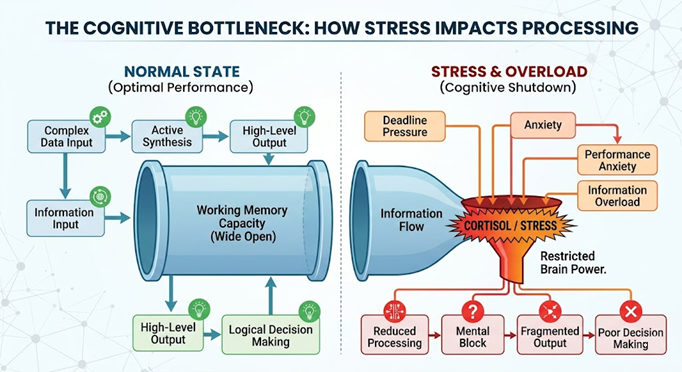
When stress enters the equation, your body’s biological “survival mode” takes over. The brain releases cortisol and adrenaline, which shifts activity away from the prefrontal cortex (the center for logic and complex thought) and toward the amygdala (the center for fear and survival).
In this state, your brain is physically incapable of performing high-level synthesis. You lose the ability to see the “big picture.” This is particularly dangerous for those in high-stakes fields where precision is a legal or medical requirement. For example, a student in an intensive healthcare program might find that the sheer volume of clinical data causes a total mental block during finals week. Seeking Nursing Assignment Help is a common and effective way to manage this “Intrinsic Load,” ensuring that technical accuracy and patient-safety standards are met even when the individual’s “Working Memory Capacity” is temporarily overstretched by the stress of clinical rotations.
Recognizing the Symptoms of “Cognitive Redlining”
Just like a car engine has a red line on the tachometer, your brain has warning signs that you are reaching your limit. If you ignore these, you hit a state of “burnout” where the brain simply refuses to engage.
- Decision Fatigue: You find it impossible to make even small choices, like what to eat for dinner.
- Reduced Empathy: When the brain is overloaded, it shuts down social processing to save energy for survival.
- Sensory Irritation: Small noises, like a ticking clock or a colleague typing, suddenly feel unbearably loud.
- Loss of Working Memory: You walk into a room and immediately forget why you are there.
Strategies for Cognitive Offloading: Moving Data Out of the Brain
The best way to lower your cognitive load is to stop using your brain as a storage device and start using it as a processing device. This is known as “Cognitive Offloading.” By moving information out of your head and onto a physical or digital surface, you free up your workbench for actual work.
The “Second Brain” Methodology
In 2026, the concept of a “Second Brain” has become essential for survival. This involves using digital tools to house all your “static” information.
- Outsourcing Research: Don’t spend hours wrestling with library databases if you are already at your breaking point. Professional researchers can provide the raw materials (the data and citations), leaving you to do the “Germane” work of final analysis.
- Visualizing the Problem: Use mind maps or flowcharts. Seeing a problem visually reduces the effort required to “hold” the structure of the problem in your mind.
Advanced Productivity Table: Managing the Load
| Strategy | Type of Load Reduced | Practical Application |
| Task Chunking | Intrinsic | Break a 5,000-word thesis into 500-word daily targets. |
| Environmental Control | Extraneous | Use noise-canceling headphones and a “distraction-free” writing app. |
| Scaffolding | Germane | Use a template or an existing outline to start your work. |
| Professional Delegation | Extraneous/Intrinsic | Hire a specialist for formatting, proofreading, or data entry. |
The Role of “Schema” in Academic Success
The ultimate goal of learning is to turn complex information into a “Schema.” A schema is a mental shortcut. For a professional driver, “shifting gears” is a schema—it requires zero conscious thought. For a beginner, it is a high-load task.
When you are overwhelmed, it is usually because you haven’t built the necessary schemas yet. This is why “expert” help is so valuable. An expert doesn’t just write for you; they provide a model of what a “perfect” schema looks like. By reviewing high-quality, professionally drafted work, your brain can see the patterns of logic and structure. This makes it much easier for you to replicate those patterns in the future, effectively lowering your cognitive load for all subsequent tasks.
Designing a “Low-Load” Life for 2026
We live in an era of information overload. We are constantly bombarded with data, and our brains have not evolved as fast as our high-speed internet. The people who succeed today aren’t necessarily the ones who work the longest hours; they are the ones who manage their cognitive architecture most effectively.
To thrive, you must become a “Gatekeeper” of your own attention.
- Stop Multitasking: Multitasking is a myth. In reality, your brain is “context switching,” which creates a massive spike in extraneous load every time you move from one tab to another.
- Use Strategic Outsourcing: Recognize when a task is “below your pay grade” or “outside your bandwidth.” Whether it’s using an AI tool for scheduling or a specialized writing service for a complex dissertation, delegating is a sign of high-level management, not weakness.
- Prioritize Sleep: Sleep is when the brain flushes out metabolic waste and moves information from the “Workbench” (Working Memory) to the “Warehouse” (Long-term Memory). Without it, your workbench stays cluttered.
Final Thoughts: Listening to the “System Warning”
When your brain shuts down, it is giving you a signal. It is telling you that your “Mental Effort” has exceeded your “Working Memory Capacity.” Respect that limit. Take a walk, clear your workspace, or find a professional partner to help carry the weight.
Managing your brain’s architecture isn’t just about getting things done; it’s about maintaining your mental health in a world that never stops asking for more. By applying Cognitive Load Theory, you aren’t just working smarter—you are ensuring that your brain stays “online” when it matters most. Success in the modern world is not about how much you can carry; it’s about how well you manage the load.
Frequently Asked Questions
What exactly is Cognitive Load Theory?
It is a psychological framework that explains how our limited working memory processes new information. The theory suggests that for effective learning to occur, we must manage the mental effort required to perform specific tasks without overloading our brain’s “processing power.”
Why does my brain “freeze” during high-pressure deadlines?
When stress levels spike, the body releases cortisol, which shifts brain activity away from the logical prefrontal cortex and toward the survival-focused amygdala. This biological shift creates a cognitive bottleneck, making it physically difficult to perform complex problem-solving or creative writing.
How can I identify if I am experiencing mental overload?
Common signs include decision fatigue over simple choices, increased irritability toward small sensory distractions (like background noise), and a noticeable drop in the ability to retain new information. If you find yourself reading the same sentence repeatedly without comprehension, your cognitive load is likely too high.
What is the most effective way to reduce a heavy mental burden?
The best approach is “cognitive offloading,” which involves moving information out of your head and onto external surfaces. This can be achieved by using detailed outlines, delegating technical research to experts, or breaking large projects into small, manageable “chunks” to prevent the working memory from collapsing.