 Richard
You want the electrical system of your home to operate silently in the background. Nevertheless, the issues are usually initiated where you may not see them at all, behind your walls. Flickering lights, warm outlets, frequently tripped breakers, or overloaded circuits can all indicate that electrical demand exceeds the capacity of the wire.
Although most homeowners pay attention to appliances or breaker panels, the wire gauge is equally vital to the safety of the system. A wire’s thickness is directly proportional to both the efficiency of movement of electricity and the heat accumulation under load.
This article describes the effect of wire gauge on the safety of your home and the pragmatic considerations that are most important in selecting the correct wiring.
1. Determines How Much Electrical Load Circuit Can Handle
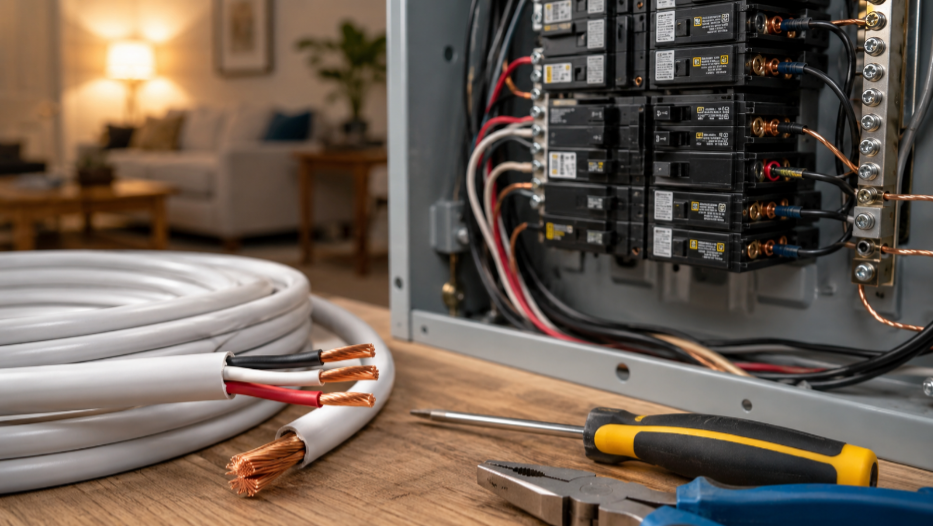
Wire gauge is not just a technical measurement. It has a direct impact on the safety of electricity passing through your house. For example, 12/3 wire is often linked to circuits with higher load-handling capacity since the conductors are thicker and therefore have lower resistance than the thinner ones. Resistance produces heat as the electric current increases, and this is a significant safety issue when the incorrect wire size is employed.
As an example, when high-demand appliances are plugged into circuits backed by undersized wiring, they may cause excessive heat to accumulate behind the walls. With time, the insulation can become weak, connections can corrode, and the threat of fire can become extremely high.
Furthermore, various household uses demand various wire gauges since there are varying electrical loads. Appliances like kitchen equipment, HVAC equipment, workshop equipment, and power tools may require wiring capable of carrying current continuously without overheating.
Thus, one of the initial steps toward ensuring a safer electrical system is the understanding of load capacity.
2. Incorrect Wire Gauge Can Lead to Overheating and Fire Hazards
Electrical fires do not usually start without warning. In most instances, the underlying cause is overheating due to wiring that is not capable of supporting the load connected to it safely.
When the wire is too thin to carry the quantity of electricity through it, resistance increases. As a result, the conductor produces excessive heat. When this heat is confined within walls, ceilings, or conduits, the risk is rapidly increased.
Moreover, insulation material also has performance limits. Protective coatings may crack, melt, or degrade as soon as they are repeatedly subjected to operating temperatures that are considered safe. This exposes conductors and heightens the chances of shorts or arcing.
This problem is aggravated by heavy-duty appliances. Space heater, air conditioner, compressor, and workshop machinery may be consuming a lot of current, particularly in the initial start-up stage.
Moreover, the environmental conditions are important. Cables that are exposed to heat, oil, moisture, and physically demanding environments may need cable types that are specially made to withstand these environments and maintain their safety and longevity.
Finally, the selection of the wire on the basis of convenience instead of electrical need poses a needless risk.
3. Voltage Drop Can Reduce Efficiency and Create Hidden Safety Problems
Safety issues are not confined to overheating. The gauge of wire also influences the voltage drop, which takes place when electrical energy becomes weak as it passes through a conductor.
Long pieces of wire are especially susceptible. When the wire is too fine, the resistance rises with distance, so the appliances and equipment are underpowered.
Initially, it might appear to be a matter of efficiency and not a safety concern. Nonetheless, equipment that is underpowered tends to be offset by consuming more current, which raises the amount of heat production and strain on the system.
As an illustration, pumps, refrigerators, compressors, and HVAC systems powered by motors might operate more intensively when the supply of voltage is intermittent. This may reduce equipment life and cause overheating issues at terminals, plugs, and internal components.
Also, voltage instability can add to nuisance breaker trips or sub-optimal equipment operation that customers erroneously attribute to the actual appliance.
Choosing the correct wire gauge in terms of both load and distance prevents undesirable variation in power delivery, in addition to minimizing unnecessary load on your electrical infrastructure.
4. Proper Wire Selection Depends on More Than Gauge Alone
Although wire gauge is critical, safe electrical design involves additional factors that should never be ignored.
First, conductor material matters. Copper and aluminum behave differently in terms of conductivity, expansion, and connection requirements.
Second, the insulation type affects where the wire can be safely used. Some cables are better suited for dry indoor applications, while others are built for moisture exposure, flexibility, outdoor environments, or harsher operating conditions.
Third, temperature ratings influence safety performance. Higher ambient heat can reduce a wire’s effective current-carrying capacity, making an otherwise acceptable gauge unsuitable.
Breaker compatibility is equally important. Circuit protection must match wire capacity. Installing a breaker rated higher than the wire can safely handle removes an essential layer of protection.
Finally, application-specific requirements matter. Branch circuits, appliance connections, workshops, garages, and specialized electrical installations may each demand different cable characteristics.
Because of this, safe wire selection should always be based on the complete operating context rather than gauge number alone.
Conclusion
Wire gauge has a direct impact on how safely your home’s electrical system performs. It influences current capacity, heat generation, voltage stability, and overall system reliability. Even a well-designed electrical setup can become hazardous if the wrong wire size is used for the application.
By understanding how wire gauge interacts with load demands, environmental conditions, and circuit protection, you make better electrical decisions that prioritize long-term safety. Small sizing mistakes can create serious consequences, whereas informed wire selection helps keep your home efficient, protected, and dependable.