 Richard
Most small businesses don’t think SEO is for them. It feels like something only big companies with deep pockets can pull off. But that’s not true, and we’re here to tell you why.
Small business SEO is one of the most fruitful things you can invest in today. It puts your business in front of people already searching for what you sell, without spending a dollar on ads. So you get steady, reliable visibility that grows over time.
After working with hundreds of clients, our team at Matter Solutions has seen local SEO help small businesses compete with brands three times their size. Time and again, it came down to one thing: getting in front of customers before anyone else did.
Honestly, search engines are where your customers are. And this guide shows you exactly how to get there.
What Is Small Business SEO and Why Does It Matter?
Small business SEO, short for search engine optimization, is simply the process of making your website easier for search engines to find and rank. It covers two main areas.
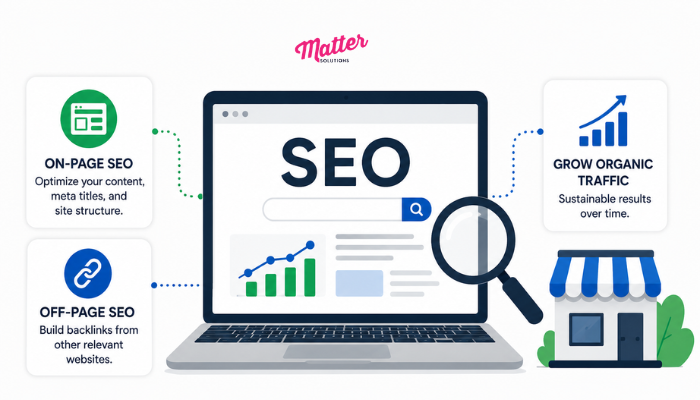
On-page SEO handles things like your content, meta titles, and site structure. Off-page SEO focuses on building backlinks from other relevant websites. Both work together to grow your organic traffic over time.
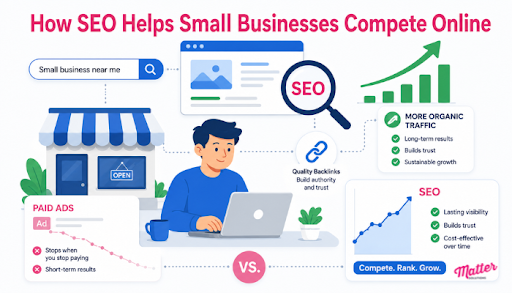
Plus, it works very differently from Google Ads. With ads, you disappear the moment you stop paying, but with SEO, your rankings stick around. Google, Bing, and other search engines keep rewarding businesses that follow the right ranking factors, whether you’re actively spending or not. That’s a big deal for small businesses working with tight budgets.
And the data backs it up. According to WordStream, 71% of small businesses investing in SEO report being satisfied with what they get back. That’s a strong return on investment for any small business budget.
Local SEO: How Local Businesses Get Found on Google
The best part about local SEO is that it puts your business in front of people who are already nearby and ready to buy. It’s about showing up for the people most likely to become customers, at the right time. And for local businesses, that effort alone goes a long way.
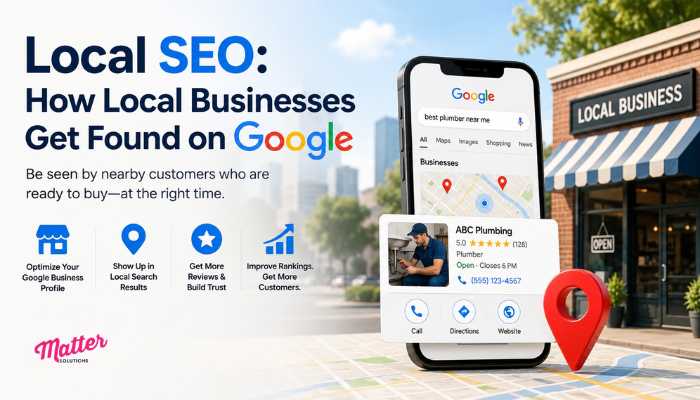
Here’s what that looks like in practice:
Setting Up and Optimizing Your Google Business Profile
Your Google Business Profile is a free listing that tells Google who you are, where you’re located, and what services you provide. Think of it as your storefront on Google. Before someone ever visits your website, this is how Google finds your business and shows it to nearby customers first.
After working with small businesses across multiple industries, we’ve found that the ones who fill out every single field on their profile show up in search far more often. That means your phone number, physical location, hours, and service list all need to be accurate and complete. Leaving anything blank is basically telling Google you’re not serious.
On top of that, positive reviews and positive ratings carry real weight. Google uses them as a trust signal, and the more you collect, the better your local SEO standing gets. So start asking happy customers to leave one.
Local Search Results: What Puts You on the Map
When someone types “best plumber near me” into Google, local search results decide who gets that call and who doesn’t. That’s just how local searches work now. People search, Google picks the most relevant local businesses, and everyone else gets skipped.
Local SEO services help you show up in those results consistently. In reality, it all comes down to how accurate your information is. Google cross-checks your business information across:
- Your website
- Your business profile
- Local business directories (like Yelp and Yellow Pages)
- Other relevant websites
If everything lines up, your local rankings improve. But if they don’t, you lose ground to competitors who got it right. That explains why so many businesses miss out on easy traffic.
Local visibility doesn’t happen by accident either. It takes consistent effort across all platforms where your business information lives. And once you nail that, the right people start finding your business without you having to chase them.
Keyword Research for Small Businesses: Where to Start
Keyword research means finding the exact words people search for when they need what your business sells. But most people guess and end up creating content that nobody is actually searching for.
That’s why getting this right from the start saves you a lot of wasted effort. And a few solid keyword research tools make the whole process a lot clearer:
- Target Keywords First: Start with the most direct phrases your customers use, like “emergency plumber Austin” or “affordable hair salon near me.” These tell you what people search for in your area, and they’re usually easier to rank for than broad terms.
- Use Free SEO Tools: Google Search Console shows you which relevant keywords are already bringing people to your site (the numbers don’t lie on this one). You can pair it with a free tool like Google Keyword Planner to find new opportunities worth chasing.
- Avoid Keyword Stuffing: Cramming keywords into every sentence doesn’t help. Google spots it immediately and penalizes your page for it. Instead, focus on user intent and write something that actually answers what someone is looking for.
Keep an eye on how your target keywords perform over time. Because small shifts in search volume can tell you a lot about what your customers want next, and that’s exactly what the next section covers.
Content Creation and Images: The Two Things Google Loves
Good content and strong images do two things at once: they keep visitors on your site and signal to Google that your pages deserve to rank. Take a look at what each one actually does:
Why High-Quality Images and Descriptive Alt Text Matter
High-quality images make your website look professional and keep visitors engaged longer. But the thing is, search engine crawlers can’t actually see your images the way a human does. Descriptive alt text solves that problem directly. It tells Google what each image shows, which helps your pages show up in image search too.
You also need to optimize images before uploading them. Large image files slow your load times down significantly, especially on mobile devices. So compress images where you can.
Worth Noting: Screen readers rely on alt text to describe visuals to users with visual impairments, which means good alt text helps real people too.
How Content Creation Builds Trust With Google and Readers
Content creation is about publishing pages, blog posts, and service descriptions that answer the questions your customers are already asking. Drawing from our experience at Matter Solutions, the businesses that publish relevant content consistently are the ones that build real traction over time.
On-page SEO plays a big role here. A good meta description and a clean meta title tell Google what a page covers before anyone clicks on it. If you get both right, they improve your click-through rate and push your page toward rich snippets in search results.
And linking between pages and other pages on your site keeps visitors moving through your content, which sends strong engagement signals back to Google.
Can a Small Business Really Compete With Big Brands Online?
Yes, a small business can compete with big brands online, but only if it focuses on the areas where large competitors simply don’t show up.
Usually, big brands chase broad, high-volume searches. So they’re not spending their budget on “best family dentist in Naperville” or “affordable dog groomer in Boise.” That’s your space to own. And local searches like those convert at a much higher rate than generic ones.
In fact, search visibility in local and niche markets is where small businesses consistently get the upper hand. A focused local SEO effort builds local authority over time, and that compounds.
Your organic rankings grow, keyword rankings climb, and local visibility starts showing up in places your competitors haven’t touched. When you’re starting out, an experienced SEO specialist can help you find those gaps faster, but even a steady DIY effort gets results.
All you have to do is stay focused on your local market and let SEO do the rest.
Why Business Information Should Stay Current and Accurate Online
Outdated or inconsistent business information across the web confuses Google and sends potential customers straight to your competitors. You might be thinking, “I only need to update my website.” But Google pulls your details from a lot more places than just that.
Let’s take a quick look at where your information needs to stay accurate:
| Platform | What to Keep Updated |
| Your Website | Address, phone number, hours, services |
| Google Business Profile | Location, hours, photos, posts |
| Local Directories | Name, address, phone number |
| Social Media Profiles | Contact details, business description |
Technical SEO covers things like site structure, broken links, and browser caching, and all of them directly affect how well crawlers read your site.
Sort those out, and the experience your visitors get improves right along with it. An effortless user experience keeps visitors on your pages longer, and Google takes that as a sign your site deserves a higher spot in search results.
On top of that, Google cross-checks your details against other websites, too. That means the moment your phone number on Yelp doesn’t match the one on your site, your search results ranking takes a hit. It sounds minor, but Google catches it without fail.
Keeping everything lined up on every platform is one of the simplest things you can do for your SEO, and one of the most overlooked.
Your Next Step Toward Getting Found Online
SEO is an ongoing process that gets stronger the longer you stick with it. Small businesses that stay consistent are the ones that see measurable improvements in their organic traffic, their local rankings, and their overall visibility on search engines.
Here’s a quick recap of where to focus first:
- Set up and complete your Google Business Profile fully
- Do proper keyword research before creating any new content
- Fix broken links, enable browser caching, and clean up your site structure
- Keep your business information consistent across every platform
From there, the results start compounding. And if you want to get there more quickly, working with SEO experts who understand local markets brings in genuine change.
At Matter Solutions, we’ve helped hundreds of small businesses go from invisible to showing up in search results reliably. That too, without blowing their budget on Google Ads.Ready to see what the right SEO services can do for your business? Reach out to us today, and let’s figure out where to start.