 Richard
Chemical drain unblockers rarely work on a blocked toilet. Most solid blockages, including the kind caused by wipes, nappies, sanitary products or an object accidentally flushed, sit beyond the reach of a liquid solution and need physical removal. A plumber or drainage engineer will clear almost any toilet blockage on the first visit, usually in under an hour.
A blocked toilet is one of those things that feels urgent the moment it happens. Standing water, no flush, an anxious household. For many people, the first instinct is to pour something down there. But before you reach under the sink, it is worth understanding what chemicals can and cannot do, and when you actually need a blocked toilet plumber to sort it properly.
Most chemical drain cleaners are designed for slow-draining sinks and shower traps, not toilet blockages. A sink drain typically has a buildup of soap, grease and hair that a caustic solution can dissolve. A toilet blockage is usually a different problem entirely.
What Actually Causes Most Toilet Blockages
Before comparing solutions, it helps to know what you are dealing with. Toilet blockages fall into a few common categories:
• Wet wipes and baby wipes, even those labelled ‘flushable’
• Sanitary products, nappies and cotton wool
• Excessive toilet paper, particularly in older narrow-bore pipework
• Foreign objects, toys, phone cases, toothbrushes
• Build-up of limescale or mineral deposits narrowing the pipe over time
• Tree root ingress in older clay drainage runs
• Partial collapse or misalignment of underground pipework
Chemicals can, in theory, help with grease or organic buildup. They cannot dissolve a wet wipe, shift a limescale ridge or remove a child’s toy. For most of the blockages above, pouring chemical down the pan is not just ineffective. It adds a hazardous liquid to an already problematic situation.
What Chemical Drain Unblockers Actually Do
Chemical drain cleaners work by generating heat or a corrosive reaction to break down organic matter. That is their limit.
Caustic soda-based products can shift grease and soft organic blockages. If your toilet has slowed down noticeably over time rather than stopped suddenly, and if there is no obvious solid obstruction, a chemical solution might provide short-term relief.
They are cheap, widely available and require no specialist knowledge to use. For very mild partial blockages caused by organic buildup, they occasionally work.
Why They Fail on Most Toilet Blockages
Toilet traps and waste pipes have a curved profile that retains water at all times. That standing water dilutes any chemical you pour in before it reaches the blockage. By the time the solution works its way through, it has lost most of its potency.
Even when chemicals reach the obstruction, solid non-organic materials simply do not react. You end up with a toilet still blocked and now full of corrosive liquid, which makes it unsafe to plunge and difficult for an engineer to work on safely.
There is also a risk to older pipework. Cast iron and some older plastic pipes can be damaged by repeated chemical use. In properties with aging drainage systems, regular chemical use can accelerate deterioration.
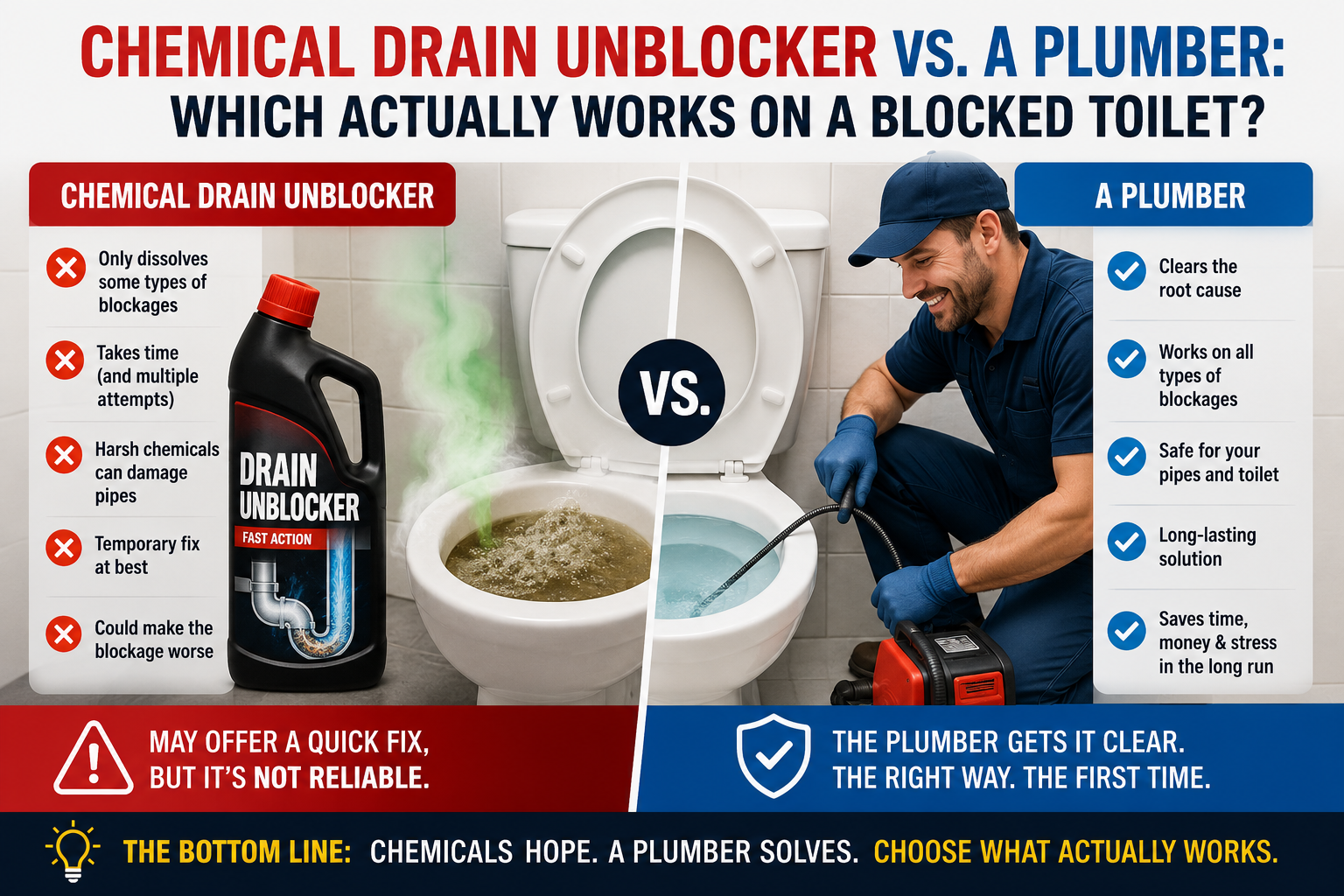
Chemical Unblocker vs. Plumber: A Practical Comparison
| Factor | Chemical Unblocker | Plumber / Drainage Engineer |
| Works on solid objects | No | Yes |
| Works on wipes / nappies | No | Yes |
| Works on grease buildup | Sometimes | Yes |
| Works on root ingress | No | Yes (with jetting) |
| Safe on older pipework | Risky | Yes |
| Can inspect the cause | No | Yes (CCTV if needed) |
| Average time to clear | Hours to overnight (if at all) | Under 1 hour |
| Suitable as first response | Partial blockages only | All blockage types |
Standard Toilet Drain Unblocking Process
1. Visual assessment of the toilet, waste pipe and any accessible inspection chambers
2. Manual or mechanical rodding to locate and dislodge the blockage
3. High-pressure water jetting if rodding is insufficient
4. Removal of any foreign objects by hand or retrieval tools
5. Flow test to confirm the drain is fully clear
6. Check of nearby manholes to rule out a wider drainage problem
7. Recommendation of any further work if damage or recurring causes are found
A toilet blockage repair service at this level typically clears the problem on the same visit. Unlike chemicals, the engineer can actually see and feel what they are working with and adjust their approach accordingly.
When to Skip the DIY Stage Entirely
Some situations call for a professional from the start. Do not waste time with chemicals or plunging if any of the following apply:
• Multiple toilets or drains in the property are blocked at the same time
• Water is backing up into other fixtures such as the bath or sink when you flush
• There is an unpleasant smell coming from drains across the property
• The toilet has overflowed or is close to doing so
• A solid object has definitely been flushed and is causing the obstruction
• The blockage has returned within a short period after previously clearing
These signs often indicate a problem further down the drainage run rather than in the toilet itself. Treating it as a simple toilet issue may clear the pan temporarily but leave the underlying problem in place.
For any blocked toilet emergency repair situation, particularly in a home with vulnerable residents or only one toilet, calling a drainage professional rather than attempting DIY is always the right call.
What About Using a Plunger?
A good quality toilet plunger is actually a reasonable first step for minor blockages, particularly those caused by too much toilet paper. A plunger creates physical pressure rather than a chemical reaction, which is a more appropriate force for what is blocking most toilet pipes.
Use a flange plunger rather than a flat-cup plunger. The rubber flange seats properly in the toilet trap and creates a genuine seal. Work with firm, steady strokes rather than aggressive thrusting, which can splash contaminated water and rarely helps.
If ten to fifteen minutes of consistent plunging makes no progress, the blockage is either solid, located further down the pipe, or lodged in a way that physical pressure from above cannot shift. At that point, stop and call an engineer.
Is Calling a Plumber Actually Worth It?
The cost concern is understandable. A drainage call-out costs more than a bottle of chemicals. But the comparison is between something that might work and something that almost certainly will.
Repeated chemical treatments that fail also cost money. More importantly, a blockage left unresolved or made worse by chemicals can result in a toilet overflow, which carries real hygiene risks and potential damage to flooring and structural materials below.
An emergency blocked toilet plumber attending quickly is almost always cheaper than dealing with the consequences of water damage from an overflow. Early intervention generally costs less than late intervention.
Final Thoughts
Chemical drain unblockers have a narrow use case. For sink traps with greasy buildup, they occasionally do the job. For blocked toilets, which are usually caused by solid materials that chemicals simply cannot affect, they are rarely the right tool.
A plunger is a fair first attempt for mild blockages. Beyond that, a qualified drainage engineer will clear the problem faster, more safely and with a much higher success rate than any product from the supermarket shelf.
For homeowners who want the job done properly, 0800 Homefix provides experienced drainage engineers who handle toilet drain unblocking across the UK. Their call-out process is straightforward, response times are fast, and they deal with everything from simple blockages to more complex underground drainage issues. No hard sell, no unnecessary work, just a clear drain and an honest assessment of what caused the problem.
Frequently Asked Questions
1. Can a chemical drain unblocker unblock a toilet?
In most cases, no. Chemical unblockers are designed for grease and organic buildup in sink traps. Most toilet blockages involve solid materials such as wipes, paper or foreign objects that chemicals cannot dissolve. A plunger or drainage engineer is a more effective approach.
2. How much does an emergency blocked toilet plumber cost in the UK?
Costs vary depending on location and time of day. Most emergency call-outs range from £80 to £200 for a straightforward blockage. More complex issues involving drain jetting or CCTV inspection will cost more. Always ask for a quote before work begins.
3. What should I do if my toilet is blocked and will not flush at all?
Stop flushing. Repeated flushing of a fully blocked toilet can cause an overflow. Use a flange plunger for ten to fifteen minutes. If there is no progress, call a drainage engineer. Do not pour chemicals in if you plan to have a plumber attend, as it creates a hazardous working environment.
4. Why does my toilet keep blocking in the same spot?
Recurring blockages usually point to a structural issue such as a partial collapse, pipe misalignment, or root ingress lower in the drainage run. A one-off blockage is usually a straightforward obstruction. Repeated blockages in the same toilet strongly suggest a CCTV drain survey to identify the underlying cause.
5. Is it safe to put bleach or caustic soda down a blocked toilet?
Caustic soda and bleach carry genuine risks. They can cause burns on contact with skin and eyes, release toxic fumes in enclosed spaces, and damage older pipework if used repeatedly. If the toilet is already overflowing or if you plan to have an engineer attend shortly, avoid adding chemicals to the situation.
6. What is the fastest way to unblock a toilet?
A flange plunger used correctly is the fastest DIY method for simple blockages. For anything more serious, calling a drainage engineer will get the toilet cleared faster than multiple failed DIY attempts. Most professional call-outs result in a clear drain within an hour of the engineer arriving.
7. Can a blocked toilet fix itself?
Not reliably. Paper-only blockages sometimes break down over time with water softening the material, but solid objects and wipes will not self-clear. Leaving a blockage untreated risks an overflow, especially if other household members continue using the toilet. It is better to address it promptly.
8. Do I need a plumber or a drainage engineer for a blocked toilet?
For a toilet blockage, a drainage engineer is often more appropriate than a general plumber. Drainage engineers carry specialist jetting equipment, rods and retrieval tools designed for drain clearing. A general plumber may not carry this equipment. Check that the company you call specifically offers drain unblocking services.